
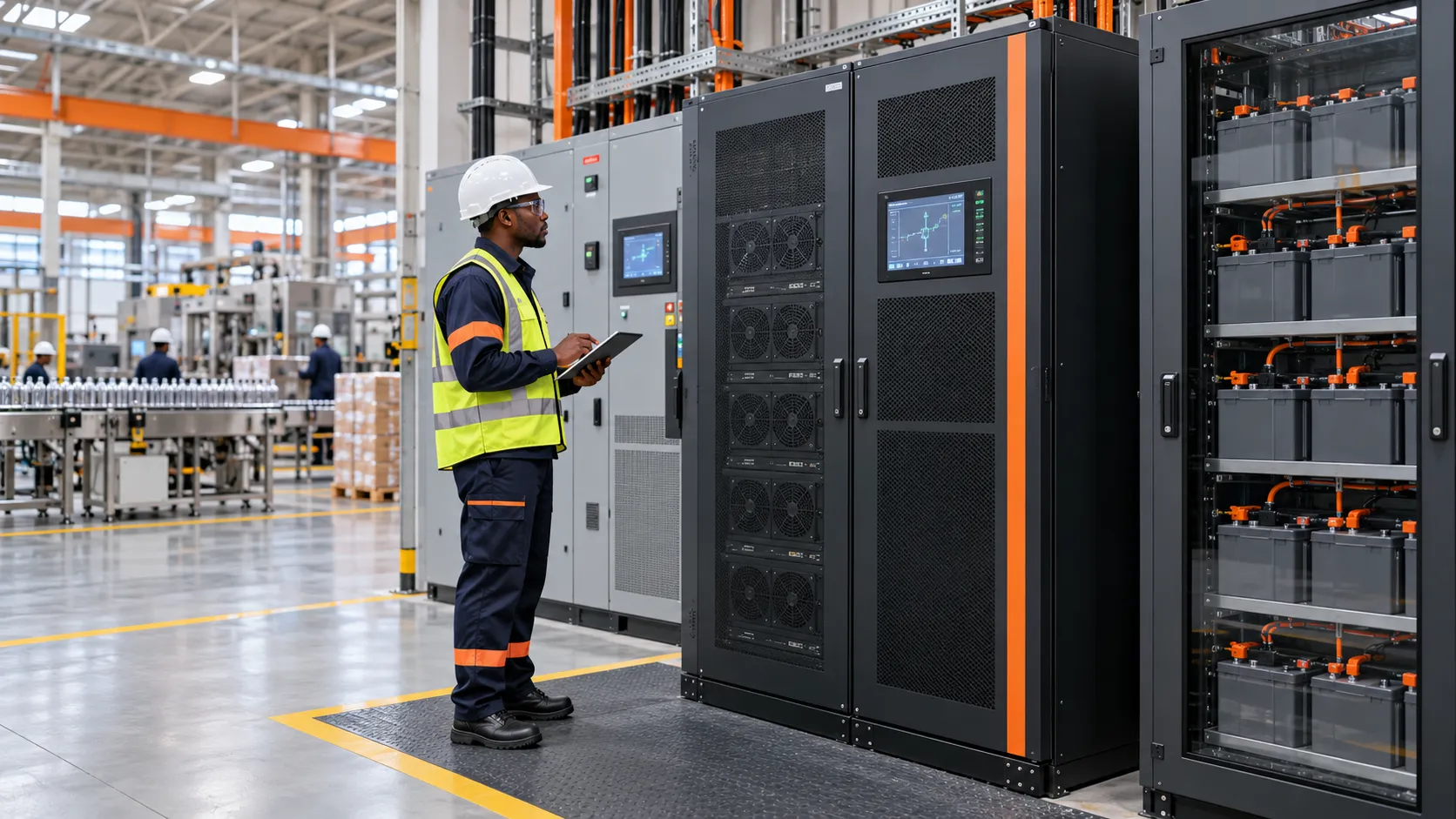
For most manufacturing facilities in Africa, the best UPS system is an appropriately sized online double-conversion UPS designed for industrial loads, high temperatures, dusty conditions and integration with generators or renewable-energy systems.
However, there is no single UPS model that is suitable for every factory. The correct solution depends on the facility’s critical equipment, total load, required backup time, operating environment, power quality and available maintenance support.
A properly engineered UPS system can protect production equipment from outages, voltage fluctuations, frequency variations, electrical noise and other power-quality problems. It can also provide enough backup time to transfer the facility to a generator, safely shut down machinery or continue essential operations.
This guide explains the main factors manufacturing plant managers should evaluate before investing in an industrial UPS system.
Power disturbances can affect a manufacturing facility even when there is no complete blackout. Voltage dips, surges, unstable frequency and brief interruptions can stop automated production lines, damage sensitive controls or corrupt operational data.
These disruptions can lead to:
A UPS provides conditioned, uninterrupted power to selected critical loads. It bridges the gap between a utility failure and generator start-up or provides time for controlled shutdown procedures.
The objective is not necessarily to power the entire factory. It is to protect the equipment and processes whose interruption would create the greatest operational, financial or safety risk.
The first step is deciding which equipment actually requires uninterrupted power.
Typical critical manufacturing loads include:
Large motors, compressors, heating systems and mechanical equipment may require a different power-protection strategy. Their high starting currents can make supporting them through a conventional UPS expensive or technically impractical.
Create a critical-load schedule showing every protected device, its rated power, starting characteristics and operational importance. This becomes the foundation for accurate UPS sizing.
UPS sizing should not be based only on adding the nameplate ratings of connected equipment.
The assessment should consider:
A UPS that is too small may overload during production changes or equipment start-up. A system that is significantly oversized can increase purchase costs and operate inefficiently at low loading levels.
A reasonable engineering allowance should be included for future expansion, but it must be based on the plant’s development plan rather than an arbitrary percentage.
Facilities with highly critical operations may also need an N+1 modular configuration. This arrangement provides additional capacity so that one power module can be taken offline or fail without interrupting the protected load.
UPS runtime should be determined by what the facility must accomplish during an outage.
Possible objectives include:
If a reliable standby generator starts and stabilizes within a short period, the UPS may only need enough battery capacity to cover the transition plus an appropriate safety margin.
A facility without dependable generation may require substantially longer battery autonomy. In this situation, a larger battery bank or integrated battery energy storage system may be appropriate.
Longer runtime increases battery capacity, floor-space requirements, cooling demand and project cost. It should therefore be justified by a business-impact and operational-risk assessment.
An online double-conversion UPS continuously converts incoming alternating current to direct current and then back to clean alternating current.
This design isolates connected equipment from many input-power disturbances and provides effectively uninterrupted transfer to battery operation.
It is generally the preferred topology for:
The trade-offs can include higher initial cost, heat output and energy losses compared with simpler UPS designs. Modern high-efficiency operating modes may reduce some of these losses, but their suitability should be assessed carefully before use with critical loads.
A line-interactive UPS can correct limited voltage variations without constantly using its batteries. It is normally less expensive and may be suitable for:
It is generally not the first choice for complex industrial processes exposed to frequent or severe electrical disturbances.
For most critical manufacturing applications in Africa, an industrial online double-conversion system offers stronger protection.
The battery system affects UPS runtime, maintenance requirements, replacement costs, footprint and overall reliability.
Valve-regulated lead-acid batteries remain widely used because they are familiar, readily available and usually have a lower initial cost.
Their limitations can include:
Lithium-ion batteries can offer:
Their initial cost may be higher, and the installation requires an appropriate battery-management system, protection measures and qualified maintenance support.
The decision should consider:
Battery selection should never be based only on the lowest purchase price.
Many African manufacturing facilities operate under demanding environmental conditions. Heat and dust can reduce UPS reliability and significantly shorten battery life.
The proposed UPS should be evaluated for:
Where possible, install the UPS and batteries in a clean, temperature-controlled electrical room. The area should have adequate ventilation, restricted access and sufficient clearance for inspection and maintenance.
Placing an indoor-rated UPS directly on a dusty production floor may result in blocked ventilation, overheating and premature component failure.
A UPS and standby generator must be designed to operate as one coordinated system.
Poor coordination can cause:
The engineering review should examine generator capacity, voltage and frequency stability, UPS input characteristics, harmonic performance and battery-recharging demand.
The generator must support both the connected critical load and the power required to recharge the UPS batteries after an outage.
Testing the complete operating sequence during commissioning is essential. This includes utility failure, battery operation, generator start-up, load transfer, battery recharge and return to utility power.
Factories increasingly combine grid power, generators, solar photovoltaic systems and battery energy storage.
A conventional UPS protects critical loads and provides immediate power continuity. A solar-BESS solution can support longer-duration energy needs, reduce generator use and improve energy management.
These systems should be coordinated carefully to avoid conflicting controls or unsafe switching conditions.
An integrated design should define:
A UPS should not be treated as a substitute for a full energy strategy. Similarly, a general-purpose battery system should not be assumed to provide the same power-quality protection as an industrial UPS.
The lowest purchase price does not necessarily produce the lowest long-term cost.
When comparing UPS systems, evaluate:
Efficiency differences become important when a large UPS operates continuously. Battery replacements can also represent a significant portion of lifetime expenditure.
A useful proposal should show both the initial capital requirement and the expected operating costs over an agreed assessment period.
An advanced UPS system provides limited value if qualified technicians, replacement components and emergency support are unavailable.
Before selecting a solution, ask:
For manufacturers in East Africa, working with a regional engineering partner can reduce delays and improve coordination throughout design, installation and ongoing maintenance.
GEMIN designs, supplies, installs and maintains industrial UPS and critical-power solutions tailored to facility loads, operating conditions and business-continuity requirements.
Before approving an industrial UPS system, confirm that the proposal includes:
An online double-conversion UPS is generally the preferred choice for critical industrial equipment because it provides continuous power conditioning and strong protection from common supply disturbances.
Capacity depends on the measured critical load, power factor, inrush current, harmonic characteristics, redundancy requirement and planned expansion. A professional load assessment should be completed before selecting the UPS rating.
Technically, large systems can support extensive loads, but powering the entire plant may not be economical. Most facilities prioritize controls, automation, safety systems, IT infrastructure and selected essential processes.
Runtime should be long enough to start and stabilize the generator, complete a controlled shutdown or maintain the required process. The correct duration depends on the facility’s continuity plan.
Yes, but the UPS, solar PV, BESS, generator and switching systems must be properly engineered and coordinated. Their control sequences and protection requirements should be established during system design.
The best UPS system for a manufacturing facility in Africa is not simply the system with the highest capacity or lowest price. It is a correctly engineered solution that matches the plant’s critical loads, required runtime, power conditions, operating environment and maintenance capacity.
For critical production and control systems, an online double-conversion UPS is often the most appropriate starting point. The final design must also account for battery technology, generator coordination, environmental protection, redundancy, future expansion and total cost of ownership.
A site assessment and load study should be completed before procurement. This reduces the risk of under-sizing, unnecessary expenditure and poor performance after installation.
GEMIN helps industrial facilities assess critical loads and develop dependable UPS, battery-storage and integrated backup-power solutions.
Contact the GEMIN engineering team to discuss system design, equipment supply, installation, testing, commissioning and preventive maintenance for your manufacturing facility.
GEMIN combines engineering expertise, technology partnerships and disciplined execution to deliver reliable infrastructure across energy and digital systems.